A forklift maintenance service contract helps control downtime, repair costs, and safety risk. Learn what to include before you sign.
A forklift maintenance service contract helps control downtime, repair costs, and safety risk. Learn what to include before you sign.
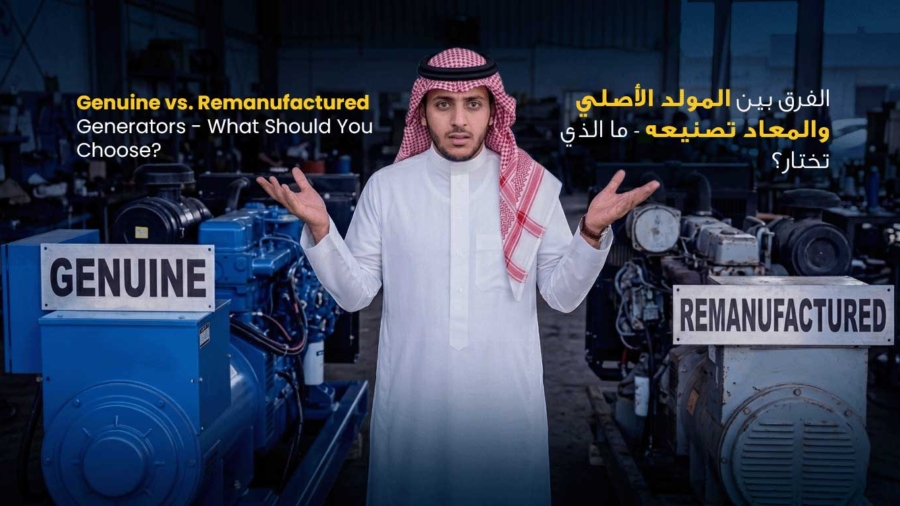
When you need to purchase a generator for a project, factory, hospital, or residential tower, you face a direct practical question: should you buy a brand-new OEM generator through an authorized dealer, or go with a remanufactured unit at a lower price? The decision is not straightforward — the right answer depends on your application, budget, and what you expect from the machine over the long term.
In this article, we lay out the real differences objectively, based on our hands-on experience in generator maintenance and supply in the Eastern Province of Saudi Arabia.
A brand-new OEM generator is manufactured entirely at the original factory using 100% new components, delivered with an official warranty through an authorized dealer. Major brands in this segment include Cummins, Perkins, MTU, Kohler, Doosan, Caterpillar, and Volvo Penta.
| Advantages: | Disadvantages: |
| All components are new and have never been operated | Significantly higher upfront cost |
| Official warranty covering the engine, alternator, and control panel | Lead time may extend to weeks or months for custom orders |
| Performance fully matches technical specifications from day one | |
| Clean service history from zero hours | |
| Suitable for critical applications: hospitals, telecom stations, data centers |
A remanufactured generator is a previously used unit that has undergone a professional remanufacturing process: complete disassembly, inspection, replacement of worn components with new or reconditioned parts, reassembly, and testing against defined operational standards.
| Advantages: | Disadvantages: |
| Price is 30–60% lower than a new OEM unit | Quality varies significantly between suppliers |
| Typically available immediately without long lead times | Full engine history is not always known |
| Suitable for temporary or backup applications | Remaining operational life is shorter than a new unit |
| Reputable remanufacturers offer a limited warranty (6–12 months) | Spare parts availability may become limited in later years |
| Criteria | OEM New Generator | Remanufactured Generator |
| Component Condition | 100% new | Mix of new and reconditioned |
| Warranty | Official dealer warranty (1–2+ years) | Limited (6–12 months) |
| Expected Service Life | 20,000–40,000 hours | Depends on remanufacturing quality |
| Relative Price | Reference | 30–60% lower |
| Immediate Availability | May require advance order | Usually in stock |
| Best Suited For | Critical & long-term applications | Standby or temporary use |
| High-load Reliability | Excellent | Depends on supplier |
If the generator will run continuously (Prime Power) or serve a critical facility, choose a new OEM without hesitation. If it’s for emergency standby or a time-limited project, a remanufactured unit from a trusted supplier is a valid option.
The price difference is real and can be significant. But calculate the Total Cost of Ownership: a more expensive new generator today may cost you less over 10 years in terms of maintenance, reliability, and avoided downtime.
A remanufactured generator from a reputable company with documented processes and verifiable track record is entirely different from one rebuilt in an unknown workshop. This difference is the gap between a great deal and a guaranteed loss.
In the local market, you sometimes find generators sold as “remanufactured” that are actually just cleaned and painted used units. The key distinction:
Always request the inspection report, list of replaced components, and load test certificate before any purchase.
At Millennium Power Organization (MPOM), we supply both options – brand-new OEM generators and quality remanufactured units from verified sources – backed by after-sales service and scheduled maintenance for major brands: Cummins, Perkins, MTU, Kohler, Doosan.
We help you choose the right generator for your actual requirement — not just the lowest price.
Millennium Power — We guide you to the right choice before you buy.
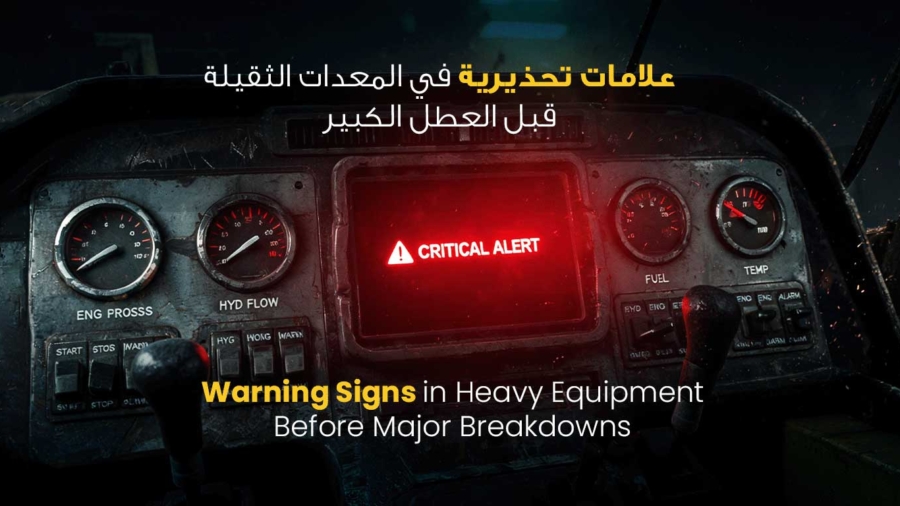
In the world of contracting and industrial projects, having equipment fail in the middle of a job is not just an inconvenience; it results in direct financial loss, project delays, and added pressure on the entire team.
A truth known by every professional maintenance expert: heavy equipment rarely breaks down suddenly. It usually warns you well in advance, but many operators do not know how to read these warnings.
In this article, we review the most prominent signs that precede major breakdowns in heavy equipment such as excavators, cranes, loaders, and dump trucks, based on our field experience in Dammam and the Eastern Province.
Oil is the engine’s lifeblood. If you pull the dipstick and find:
Action: Any change from normal oil color requires an immediate stop and inspection. Do not wait for the scheduled maintenance.
Does the temperature gauge slowly rise above the green zone? This is not “normal for summer.” Persistent overheating indicates:
Real danger: If the temperature exceeds the maximum limit even once without stopping the equipment, it can cause deformation of the cylinder head, an expensive repair that may take weeks.
Healthy equipment has a steady, familiar sound recognizable to the experienced operator. Any change in sound is a signal:
Advice: Train operators to report any new sound immediately; they are the first to hear issues.
Finding oil or fluid spots under the equipment after just one night of downtime is not “acceptable.” Each fluid has a color and meaning:
| Color | Likely Source |
| Dark black | Engine oil |
| Red or light brown | Hydraulic oil or transmission fluid |
| Green or orange | Coolant |
| Clear yellow | Brake or steering fluid |
Slow leaks become large leaks, and large leaks lead to sudden breakdowns at the worst time.
The hydraulic system is the heart of excavators, cranes, and loaders. Notice if:
These indicate low hydraulic oil, oil contamination, seal failure, or early wear in the pump or valves. Ignoring this leads to damage to the main pump or hydraulic distributor, which are very costly parts to replace.
Modern equipment is equipped with ECU/ECM systems that monitor dozens of variables in real time. If any warning light turns on:
Tools like Jaltest and Nexiq provide the full error code and exact diagnosis for all major equipment brands: CAT, Komatsu, Volvo, Liebherr, JCB, Sany, and more.
If you regularly add engine oil without seeing an external leak, the engine is burning oil internally. Common causes:
Accompanying sign: light blue smoke from the exhaust, especially during acceleration or startup.
Dump trucks or mixers that start to delay gear engagement or make noise when shifting are showing early gearbox or clutch problems. Early repair usually means replacing a single part. Ignoring it may cause complete gearbox failure.
In heavy equipment maintenance, engineers know this rule well: every one Riyal you spend on preventive maintenance saves you ten Riyals on repairs. Regular maintenance, early warning checks, and electronic diagnostics are the real recipe for keeping your fleet running efficiently.
At Millennium Power Organization (MPOM), we provide on-site field inspections and full electronic diagnostics for heavy equipment at your location or in our workshop in Dammam.
We work with all major brands:
CAT · Komatsu · Volvo · Liebherr · JCB · Sany · Terex · Doosan
And heavy trucks: Volvo · Scania · MAN · Mercedes-Benz
Our technical team is equipped with Nexiq and Jaltest diagnostic tools and has extensive field experience in Gulf working environments.
Millennium Power Organization — We discover the problem before it discovers you.