Why the Controller Is the Brain of Your Generator
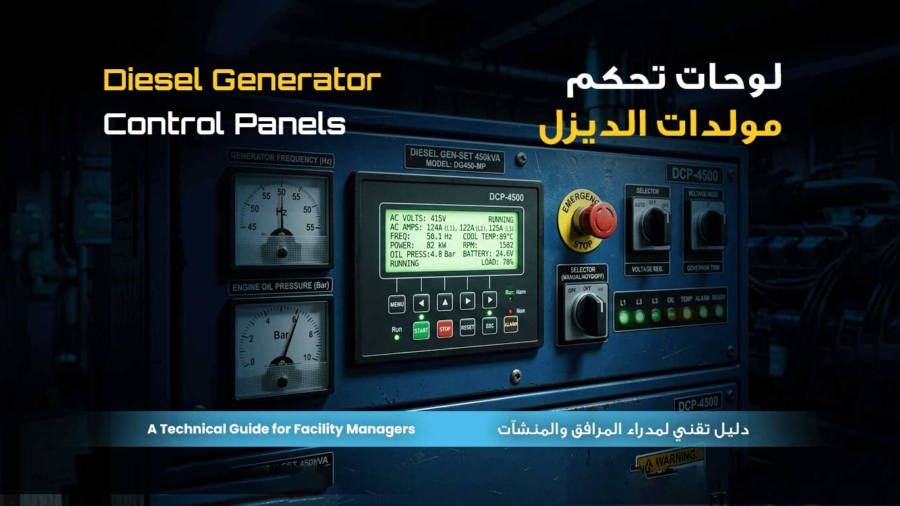
When a backup generator fails at a hospital, factory, or hotel, the cause is rarely the engine itself. In more than 60% of the cases we handle at Millennium Power Company, the fault lies in the control panel — the electronic brain that manages starting, protection, and load transfer.
Control systems have evolved dramatically over the last decade, yet many operators still treat them as sealed black boxes. That misunderstanding costs facilities downtime and expensive failures that could have been avoided with proper programming or a timely upgrade.
The Four Generations of Control Systems
1. Manual Start — Legacy systems requiring human intervention for every start and stop. Still found at some temporary construction sites.
2. Auto Mains Failure (AMF) — Senses interruption of the utility supply (Saudi Electricity Company / SEC) and starts the generator automatically. The standard choice for hotels and smaller hospitals.
3. Automatic Transfer Switch (ATS) — Transfers loads between mains and generator without human intervention, with a programmed time delay. Mandatory for critical facilities.
4. Synchronization and Paralleling — Operates several generators together, or in parallel with the utility grid. Essential for data centers, large hospitals, and refineries.
Major Controller Brands in the Saudi Market
Deep Sea Electronics (DSE) – United Kingdom
The most widely deployed brand in the Eastern Province. Common models:
- DSE 7310 MKII — single set, AMF, standard choice for mid-size facilities
- DSE 7320 MKII — with integrated ATS function
- DSE 7420 MKII — advanced protection and communication features (Modbus, Ethernet)
- DSE 8610 / 8660 — multi-set paralleling and synchronization
ComAp – Czech Republic
Premium-tier, frequently specified in large industrial installations:
- InteliLite — single set
- InteliCompact NT — paralleling
- InteliGen NTC — large plants
Smartgen – China
Very common on Chinese-built gensets imported into KSA:
- HGM6120 — AMF unit
- HGM6320 — ATS unit
- HGM9510 — synchronization
OEM Controllers
- Doosan — typically Smartgen-based
- Cummins PowerCommand (PCC 3.3, PCC 2100)
- Perkins — typically rebadged DSE
- MTU MMC
- Kohler — proprietary systems
Critical Protection Functions
Any credible controller must provide at a minimum the following protections:
| Protection | Purpose | Consequence if Missing |
| Over/Under Speed | Engine protection | Crankshaft damage |
| Over/Under Voltage | Load protection | Burnout of electric motors |
| Over/Under Frequency | Sensitive load protection | Electronics equipment failure |
| Low Oil Pressure | Engine protection | Bearing and crankshaft damage |
| High Coolant Temperature | Engine protection | Cylinder head cracking |
| Overload | Generator protection | Stator winding burnout |
| Reverse Power | Paralleling systems | Generator destruction |
Common Faults and Their Root Causes
The most frequent issues we diagnose in our workshop:
Fail to Crank/Start — incorrect cranking time parameter, faulty RPM pickup sensor, weak starter battery, or defective fuel solenoid.
False Overheat Shutdown — faulty temperature sensor, or incorrectly programmed set point.
Failure to Transfer — defective ATS contactors, or incorrect mains detection settings.
Random Shutdown — voltage instability, sensor malfunction, or electromagnetic interference (EMI) from nearby equipment.
Battery Fault with Healthy Charging — wrong charging voltage parameter set in the controller.
Why Proper Programming Matters as Much as the Hardware
When we receive a new generator for installation, factory programming is rarely suited to local conditions:
- Eastern Province ambient temperatures require different operating temperature thresholds
- Saudi grid quality requires precise tuning of mains failure detection windows to avoid false transfers
- Industrial load profiles need dynamic load and current limit calibration
- Communication protocols (Modbus, J1939) are required to integrate with BMS and SCADA systems
At MPOM we program and tune controllers using official manufacturer tools: DSE Configuration Suite, ComAp InteliConfig, Smartgen configurators, plus OEM utilities such as Cummins InPower and Perkins PEDS.
Upgrade or Repair? A Decision Framework
| Condition | Repair | Replace / Upgrade |
| Controller age < 8 years, isolated fault | ✅ | — |
| Controller age > 12 years | — | ✅ |
| Spare parts no longer available | — | ✅ |
| No support for Modbus TCP / Ethernet | — | ✅ |
| Faults only in external sensors | ✅ | — |
| Need for remote / IoT monitoring | — | ✅ |
Upgrading from a legacy controller (e.g., DSE 7220 to DSE 7320 MKII) typically delivers: better self-diagnostics (event log), remote cloud monitoring, and 5–12% fuel savings through improved operating logic.
MPOM Capabilities in Control Systems
- Diagnostics and repair for all major controllers (DSE, ComAp, Smartgen, Cummins, Perkins, Kohler, MTU)
- Upgrade of legacy systems to current-generation models
- Site-specific programming and parameterization
- Integration with BMS and SCADA systems
- Installation of multi-set synchronization and paralleling systems
- 24/7 emergency response for critical facilities (hospitals, data centers, hotels)
How to Request a Controller Assessment
- Send via WhatsApp: photo of the existing controller + screen photo of the fault + generator capacity (kVA) and model
- For critical facilities (hospital, factory, hotel): arrange a technical site visit for comprehensive assessment without shutdown
- For emergencies: 24/7 service across Dammam, Khobar, and Jubail
Millennium Power Company (MPOM) — Specialists in diesel generator maintenance and control systems in Dammam and the Eastern Province.