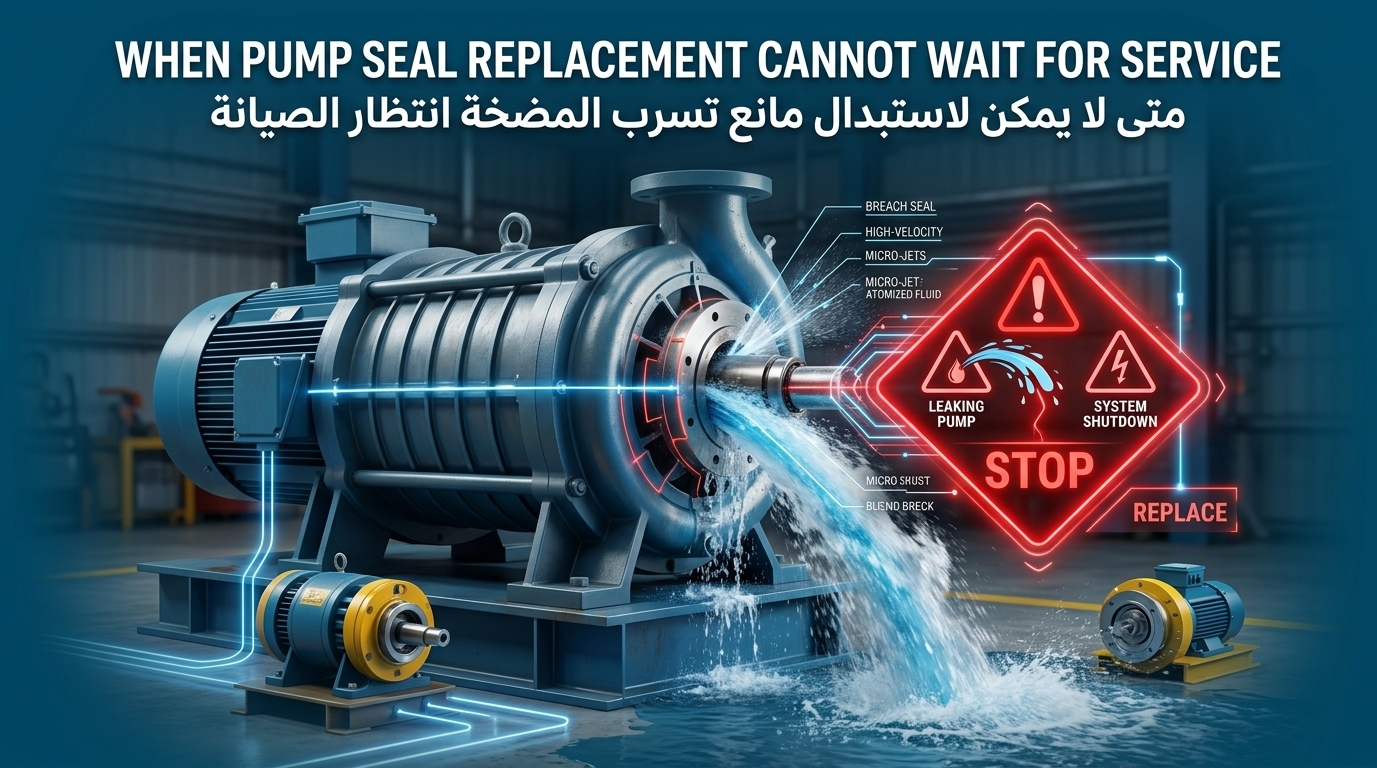
A pump can still move water while its seal is failing. That is what makes the problem expensive. A small leak at the seal chamber can quickly become bearing damage, motor contamination, lost process pressure, safety exposure, or an unplanned shutdown. Timely pump seal replacement is not simply a leak repair. It is a controlled maintenance action that protects the complete pumping system and the operation that depends on it.
For industrial water pumps, dewatering systems, booster pumps, and transfer applications, the correct response depends on the liquid, operating pressure, pump condition, and the reason the seal failed. Replacing the seal without identifying that cause may restore service briefly, but it can lead to another failure soon after.
Signs That a Pump Seal Needs Attention
Visible leakage is the clearest warning, but it should be assessed correctly. Mechanical seals are designed to operate with an extremely thin lubricating film between their faces. A brief trace of moisture during initial operation may be normal on some systems. Continuous dripping, a growing wet area beneath the pump, spray from the seal area, or liquid reaching the bearing housing is not.
Operations teams should also pay attention to changes that appear before a major leak. A pump that runs hotter than usual, produces abnormal noise, vibrates more heavily, loses discharge pressure, or requires frequent top-ups may have a seal-related issue. On pumps handling hot water, chemicals, wastewater, or abrasive water, crystallized deposits and staining around the seal housing provide further evidence that the seal environment is not under control.
A seal failure can also affect equipment outside the pump. Escaped fluid may damage couplings, corrode baseplates, contaminate nearby electrical equipment, or create a slip hazard. Where the pump supports fire protection, process cooling, drainage, or critical utility supply, even a minor leak deserves a planned response before it becomes an emergency.
What Causes Mechanical Seal Failure?
Mechanical seals rarely fail for only one reason. The seal faces may be worn, cracked, overheated, or chemically attacked, but the underlying problem may be hydraulic, mechanical, or installation-related. A reliable repair begins with diagnosis rather than assuming the old seal simply reached the end of its life.
Dry running is one of the most damaging conditions. Without adequate liquid at the seal faces, friction creates heat rapidly and can damage carbon, ceramic, silicon carbide, elastomers, and secondary sealing components. Loss of prime, blocked suction lines, closed valves, low tank levels, air ingress, and poor venting can all create dry-running conditions.
Misalignment and vibration are equally common contributors. A bent shaft, worn bearings, soft foot, damaged coupling, pipe strain, or an imbalanced rotating assembly can prevent the seal faces from maintaining stable contact. The result may be heat, face chipping, secondary seal damage, and recurring leakage. Replacing a seal while leaving excessive shaft runout or bearing play unresolved wastes both parts and labor.
The pumped liquid matters as well. Sand, scale, rust, and suspended solids can score seal faces. High temperature can harden or distort elastomers. Chemicals may swell, crack, or degrade materials that are not compatible with the service. For this reason, the replacement seal must be selected by more than pump model. Fluid type, temperature, pressure, speed, solids content, and duty cycle all affect the correct materials and design.
Pump Seal Replacement Starts With System Checks
Before disassembly, isolate the pump, lock out the electrical or engine-driven power source, close and secure relevant valves, and relieve all pressure. Drain or contain the liquid according to site safety procedures. This is especially critical when the pump handles hot, contaminated, flammable, or chemically treated fluids.
The technician should then inspect the full installation. Check suction conditions, valve position, strainers, piping support, coupling condition, motor or engine alignment, baseplate integrity, and evidence of cavitation. Cavitation often produces noise and vibration that operators describe as gravel or marbles moving through the pump. Its hydraulic shock can contribute to seal and bearing damage, so it must be corrected at the source.
Once the pump is opened, inspect the shaft or sleeve where the seal sits. Grooves, corrosion, pitting, and runout can prevent a new seal from sealing correctly. The seal chamber, gland plate, impeller, wear rings, bearings, and shaft hardware should also be examined. If leakage has been present for an extended period, a bearing inspection is necessary because fluid contamination can shorten bearing life significantly.
Selecting the Correct Replacement Seal
A mechanical seal is a matched assembly, not a generic interchangeable component. Correct selection requires confirmation of the pump make and model, shaft diameter, seal chamber dimensions, rotation, and the original seal arrangement. It also requires a clear understanding of the pumped media and normal operating conditions.
A single mechanical seal may suit clean water applications with moderate pressure and temperature. More demanding duties may require a cartridge seal, a double seal, specialized face materials, or elastomers selected for chemical and thermal compatibility. In abrasive service, hard-face combinations and better solids management may be necessary. In applications with hazardous or environmentally sensitive fluids, leakage control requirements can justify a higher-specification arrangement.
There is a cost trade-off. The lowest-priced replacement may be appropriate for a noncritical clean-water pump with predictable duty. It is rarely the best choice for a process pump where a repeat failure stops production or creates a safety issue. Procurement decisions should consider expected service life, availability of compatible spare parts, repair access, and the cost of downtime, not only the purchase price.
Installation Details That Determine Seal Life
Cleanliness is essential during pump seal replacement. Dirt, grit, fingerprints, and damaged O-rings can compromise the seal before startup. Seal faces should not be touched with bare hands or wiped with unsuitable materials. All parts must be clean, correctly lubricated where the manufacturer specifies, and installed without forcing components over sharp shaft edges or keyways.
The stationary seat and rotating assembly must be positioned at the correct working length. Cartridge seals simplify this process because they are preset, but their setting clips must be handled according to the manufacturer’s procedure. On component seals, incorrect spring compression or face setting can lead to immediate leakage, overheating, or rapid wear.
After reassembly, align the driver and pump accurately. Final alignment should be checked after piping is connected because unsupported or strained pipework can pull the pump casing out of position. Confirm that guards are restored, fasteners are tightened to the correct specification, and the pump can rotate freely by hand before energizing it.
Startup and Verification After Seal Replacement
Do not start a pump until it is properly primed and the suction path is ready. Confirm that isolation valves are in the correct operating position, vents have been managed, and the pump has liquid available at the seal faces. Starting against an unsuitable discharge condition or allowing the pump to run dry can destroy a new seal within minutes.
During initial operation, monitor leakage, suction and discharge pressure, vibration, noise, bearing temperature, and motor load. A short supervised run is the best time to identify incorrect rotation, air binding, unstable flow, or installation errors. Record the readings as a baseline for future maintenance checks.
Follow-up inspection matters. A pump may appear satisfactory immediately after repair but show leakage after thermal expansion, pressure cycling, or normal operating vibration. A scheduled check after the first operating period helps catch these issues before they affect the wider system.
Preventing Repeat Seal Failures
The most effective approach is to treat the seal as part of a maintenance program rather than an isolated consumable. Routine pump inspections should include leak checks, vibration trending, bearing condition, alignment verification, suction strainer cleaning, and review of operating conditions. If a pump repeatedly loses seals, document the failure pattern and investigate the system, not just the part.
Maintain accurate records for seal type, installation date, fluid service, observed failure mode, and related repairs. These details allow maintenance teams to identify whether failures are linked to one pump, one application, a particular operating shift, or a recurring parts specification issue. They also support better spare-parts planning for critical assets.
For operations in Dammam, Dhahran, Khobar, Jubail, and Alahsa, a qualified field service partner can reduce the time between diagnosis, parts confirmation, repair, and return to service. MPOM supports industrial pump repair with practical troubleshooting, seal and component replacement, alignment checks, and parts sourcing focused on restoring dependable operation.
A leaking pump is a useful early warning, not a condition to manage indefinitely. Address the cause while the pump is still available for planned maintenance, and the next seal replacement can become a controlled job instead of a costly interruption.